Students
Travel
to
Drexel
University
to
Utilize
Scanning
Electron
Microscope
Students
Get A
glimpse
into The
World of
the
Unseen
Lansdale, Pennsylvania—February 13, 2008—Students
in the
North Penn High School Engineering Academy
program named
The Future is N.E.A.R. (Nanotechnology
Education And Research)
recently traveled to Drexel University in
Philadelphia to work with
Dee Breger, Director
of Microscopy,
to utilize their Scanning Electron
Microscope, or SEM for short.
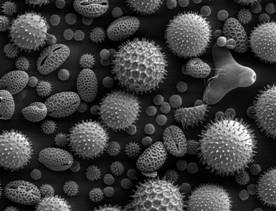
Image 1: Pollen from a variety of
common plants
(Magnification: 500x)
A Scanning Electron Microscope
is an electron microscope which
allows it’s users to indirectly
observe objects at an extremely high
magnification utilizing a high
energy, focused beam of electrons
under vacuum.
Image 1 directly to the left
shows what common pollen looks like
under the magnification of an SEM.
This image was taken at only 500X.
Ms. Breger demonstrated and taught
the major functions of the Drexel
SEM to the engineering academy
students just before she allowed
them to take over its operation.
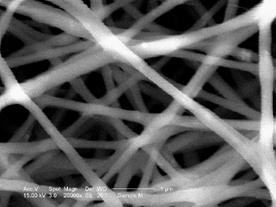
The students captured highly
magnified views of their electrospun
nanofibers (20,000x and higher) to
identify surface characteristics and
to plot diameter measurements. Most
of the students’ nanofibers measured
less than 200 nanometers! (See image
2)
To put this scale into perspective, a
nanometer is one billionth of a meter (1 x10⁻⁹
meters) and the average human hair is around
75,000 nanometers. The polymer nanofibers
that the students created were so small that
they could not bee seen individually with
the naked eye, they could only be seen with
the aid of the SEM at
Drexel University.
The data that the students
collected will prove to be useful when the
students return to school to begin their
statistical analysis. Preliminary reports
from the students' research are showing some
promising conclusions and two students may
have developed a mathematical model that can
be utilized to predict fiber characteristics
before the electrospinning process even
begins. Further examination of the results
will need to be made by the students before
any final conclusions can be drawn.
There are many applications for polymer
nanofibers, such as: highly selective
particulate filters, biomedical applications
for cell scaffolding and cell growth, optic
nerve regeneration, counterfeit
applications, etc. The students will soon
be designing experiments to try to create
magnetic and conductive fibers as well as
fibers with select surface characteristics
for various applications.
To read more about nanotechnology, the
research the students are performing or if
you have any questions, please visit the
website at:
http://www.thefutureisnear.org